
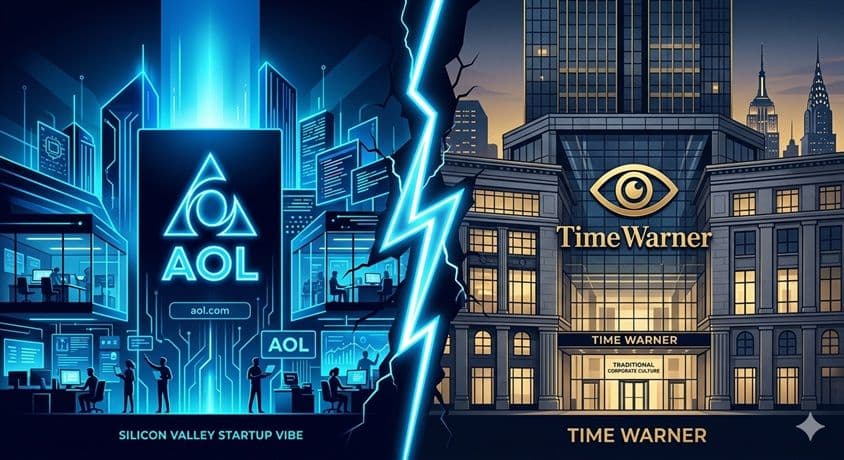
Introduction: The Merger That Promised a New Digital Era but Ended in Failure
In January 2000, the world witnessed the announcement of what was hailed as a revolutionary merger: AOL and Time Warner, two giants from different worlds, came together in a $165 billion deal that was meant to redefine the future of media and technology. Yet, less than a decade later, the merger unraveled, becoming one of the most significant corporate failures in history. So, what went wrong?
Why the Merger Was a Good Plan: Visionary Strategy with Potential Synergies
The AOL-Time Warner merger wasn’t just a hasty decision; it was a strategic move based on sound logic—at least on paper.
- AOL’s Strengths: AOL’s Strengths: At the time, AOL was the undisputed leader of the internet, with over 30 million subscribers. Its stock was soaring, and it had significant influence over the emerging digital landscape.
- Time Warner’s Strengths: Time Warner was a media behemoth, with a vast content library, including CNN, HBO, Warner Bros., and Time magazine. They had the content; AOL had the distribution network.
- The Strategic Vision: By merging, the companies aimed to create a synergy where AOL’s online platform would deliver Time Warner’s content to millions of users, integrating traditional media with new digital platforms. This was expected to drive customer growth, increase revenues, and position the new entity as the leader in the digital media revolution.
What Happened in 2000 and 2001: The Bubble Bursts
- Initial Optimism: The merger was announced with great fanfare, with the combined company valued at $350 billion based on stock prices. Expectations were high; projections indicated massive customer growth, increased revenue, and enhanced profitability.
- The Dot-Com Bubble: As 2000 progressed, the dot-com bubble, which had inflated AOL’s stock price, began to burst. This bubble had been fueled by rampant speculation in internet companies, leading to sky-high valuations that were not supported by underlying business fundamentals.
- Economic Downturn: The burst of the dot-com bubble triggered a broader economic downturn. The collapse of tech stocks, including AOL’s, drastically reduced the combined company’s market capitalization. The economic downturn also meant reduced advertising revenue, a critical income stream for AOL, and slower-than-expected broadband adoption, which undermined the expected growth in subscribers and revenue.
- Financial Impact: By 2001, AOL’s stock had plummeted, and the company faced declining revenues. The anticipated customer growth did not materialize, and the integration of AOL’s internet services with Time Warner’s content was fraught with challenges. The combined company reported significant revenue but struggled to maintain profitability. AOL’s advertising revenue, which was supposed to drive the merger’s success, began to decline sharply, contributing to a steep drop in EBITDA and net profits.
What Led to Failure: Cultural Clashes and Strategic Misalignment
Several factors contributed to the failure of the AOL-Time Warner merger:
- Overvaluation of AOL: The deal was predicated on AOL’s inflated stock price, which collapsed once the dot-com bubble burst. This overvaluation led to a goodwill write-down of $99 billion in 2002, a record-breaking loss.
- Cultural Clashes: One of the most significant and underestimated issues was the cultural clash between AOL and Time Warner. AOL, a fast-paced, tech-driven company, operated with an aggressive, risk-taking mindset typical of Silicon Valley startups. In contrast, Time Warner had a more traditional, conservative corporate culture, deeply rooted in the entertainment industry. These differences manifested in day-to-day operations as conflicting approaches to decision-making, leadership styles, and employee engagement.
- Missed Synergies: The expected synergies between AOL’s platform and Time Warner’s content were never fully realized. The technological integration proved more challenging than anticipated, with different teams working in silos rather than collaboratively. The strategic goals of both companies were not as aligned as they initially appeared, leading to missed opportunities and inefficiencies.
- Leadership Failures: Steve Case (AOL) and Gerald Levin (Time Warner) had different visions for the company. This misalignment at the top created a lack of coherent strategy, with neither leader able to navigate the merged entity through the turbulent market conditions. The absence of a unified direction further exacerbated the integration challenges.
Business Lessons to Learn from the AOL-Time Warner Case Study
The AOL-Time Warner merger offers several critical lessons for businesses considering mergers and acquisitions:
- Realistic Valuation: Ensure that valuations are grounded in reality, not market hype. Overvalued assets can lead to catastrophic financial write-downs.
- Cultural Integration: Cultural compatibility is crucial in any merger. Without alignment in values and work culture, even the most logical mergers can fail. Addressing cultural integration early and actively managing cultural differences is essential for post-merger success.
- Synergy Realization: Theoretical synergies need to be carefully planned and realistically achievable. Overestimating potential synergies can lead to unmet expectations and financial losses. Clear, actionable plans are necessary to turn potential synergies into real business outcomes.
- Leadership Alignment: Clear and unified leadership is essential in navigating post-merger challenges. Misalignment at the executive level can doom even the most promising mergers. Leaders must communicate effectively and work together to drive the merged entity towards a shared vision.
- Adaptability: The ability to adapt to changing market conditions, especially in volatile industries like technology, is crucial. Rigid strategies often fail in the face of rapid change. Companies must remain agile and responsive to external factors, particularly during the post-merger integration phase.
Key Figures Before and After: The Transformation of Leaders and Financials
- Steve Case (AOL’s CEO): Initially, the architect of the merger, Case stepped down as chairman in 2003 after it became clear the merger had failed. Post-merger, he focused on venture capital and entrepreneurial endeavors.
- Gerald Levin (Time Warner’s CEO): Levin resigned in 2002, taking responsibility for the merger’s failure. He retreated from public life, expressing regret over the decisions made.
Financials Pre-Merger
- AOL’s Revenue (1999)
- $4.8 billion
- Time Warner’s Revenue (1999)
- $27 billion
- AOL Market Cap (Pre-Merger)
- Nearly $200 billion
- Time Warner Market Cap (Pre-Merger)
- ≈ $100 billion
Financials Post-Merger
- Combined Revenue (2001)
- $38 billion
- Reported Loss (2002)
- $99 billion
- Market Cap (2002)
- ≈ $160 billion
- Customer Growth (Expected vs. Actual)
- AOL’s subscriber base stagnated as broadband adoption outpaced dial-up — directly impacting revenue projections.
The AOL-Time Warner merger stands as a cautionary tale in corporate strategy, a stark reminder that even the most ambitious plans can falter without careful execution, cultural alignment, and realistic expectations.
Written by Karthik Kannaiyan